About 43 minutes
Augusta Tabor: Her Side of the Scandal — Key Ideas to Explore
Historical Psychological Social Fiction
9,769 recorded words. 0 minutes difference from this book's estimate.
View Gutenberg source #50934
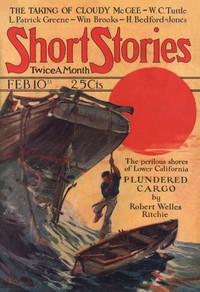
The taking of Cloudy McGee — Edition Insights can be approached with a clearer sense of reading commitment from its source measurements: 9,725 words, 43 min estimated reading time, and 2 detected text sections.
The text analysis averages about 13.1 words per sentence, while the detected sections provide another way to judge how the source is divided.
Project Gutenberg metadata also associates the work with “Short stories,” connecting these edition facts with the source record’s subject description.
Explore this collection
These alternatives are selected using recorded categories and estimated reading time.
About 43 minutes
Historical Psychological Social Fiction
9,769 recorded words. 0 minutes difference from this book's estimate.
View Gutenberg source #50934About 49 minutes
Historical Psychological Social Fiction
11,055 recorded words. 6 minutes difference from this book's estimate.
View Gutenberg source #65947About 59 minutes
Historical Psychological Social Fiction
13,438 recorded words. 16 minutes difference from this book's estimate.
View Gutenberg source #67855Search stored excerpts and compare books → Choose by your preferences →
Choices use stored catalog measurements. Estimates vary with reading speed. A shared category is a catalog label, not a claim that two books have the same argument or literary quality.
Search reads excerpt text stored with this catalog and links to its associated Gutenberg record. The connection is stored in the site database; this tool does not recheck that every excerpt is word-for-word identical to that external record. Excerpt search does not cover every chapter and does not verify historical publication dates.
Catalog snapshot checked: 2026-09-26. Coverage: 94 public books, 94 available source excerpts.
Calculated from edition completeness, EPUB availability, text structure and catalogue metadata. Not a user rating.
Total of 100 points, scaled to a 2.5-5.0 range. Editions with an empty description or a missing EPUB file are not scored.
Public-domain source text
The source text is kept in the dedicated reader, separate from this catalogue record and its commentary.
W. C. Tuttle opens “The Taking of Cloudy McGee” with a portrait of Ferdinand P. Putney, a lawyer whose appearance—six feet three, size eleven shoes, a green derby hat—suggests a man more absurd than imposing. The narrator’s deadpan observation that “fate had been kind to Ferdinand P. Putney, because he was not in jail” sets a tone of wry humor that persists throughout the excerpts. Putney’s partner in trouble, bank cashier Amos K. Weed, is described as having a “.22 caliber soul” that holds back his dreams of criminal grandeur. Together they form a duo whose schemes are undermined by their own limitations.
Tuttle sketches his characters through exaggerated physical traits and comic metaphors. Putney’s face is likened to “a very old and very wise bloodhound,” while Amos’s Adam’s-apple performs “convulsive leaps” when he tries to speak. These descriptions are not merely decorative; they establish the men as figures of fun rather than genuine threats. Amos’s voice is “of the E-string variety,” a musical analogy that underscores his squeaky, ineffectual nature. The narrator’s voice remains detached, reporting absurdities without comment—as when Putney, upon hearing they are ruined, asks “Just how are we ruined, Amos?” with theatrical calm. This technique keeps the reader at a knowing distance, amused by the characters’ self-importance.
The plot hinges on a failed oil strike and a plan to rob the bank to cover losses. But the excerpts show the scheme collapsing not through external heroism but through the incompetence of its architects. Amos, after opening the bank’s rear door for the getaway, watches Putney approach “carrying a double-barrel shotgun”—a detail that suggests the lawyer intends to double-cross the outlaw Cloudy McGee. Yet the plan is already unraveling: McGee has knocked out the damp-nosed stranger (a possible accomplice) and made off with the money. The story’s tension comes not from suspense but from watching how badly the conspirators manage every step. Tuttle’s dialogue, full of exclamations and fractured sentences (“Aw-w-w-w, it may turn out all right”), reinforces the sense of panic and poor judgment.
The town of Lost Hills is sketched with minimal detail—a bank, a lawyer’s office, a saloon called the War Path—but the excerpts convey a closed, gossipy community where everyone notices a stranger. The damp-nosed man with a cold draws immediate attention; his sneeze makes Amos “jerk as though someone had fired a gun.” The sheriff’s lighted window seems ominous to Amos’s guilty mind. Tuttle uses small, telling details: the lawyer’s feet on “a pile of dusty books,” the cashier’s habit of “looking up and down a column of figures.” These touches ground the farce in a recognizable small-town setting, where the stakes are modest—eleven thousand dollars—and the criminals are as petty as their surroundings.
Tuttle’s narrator maintains a colloquial, slightly sardonic tone throughout. Phrases like “Amos’ life consisted mostly of looking up and down a column of figures” and “he fairly slunk away” blend observation with mild mockery. The pacing varies: long, descriptive sentences introduce characters, while short, punchy lines heighten comic moments (“‘Well?’ queried Ferdinand softly. ‘Well!’ squeaked Amos.”). The excerpts also show Tuttle’s use of repetition for effect—Amos’s repeated “aw-w-w-w” and Putney’s exasperated “I wouldn’t give a thousand dollars for you, guts, feathers and all.” This rhythm gives the prose a spoken quality, as if the narrator is telling the story to a listener in a saloon.
The excerpts suggest that “The Taking of Cloudy McGee” is less a conventional western than a comedy of errors dressed in cowboy clothes. Readers who expect a straightforward tale of bank robbery may be surprised by the emphasis on character flaws and verbal humor. The story rewards attention to physical comedy and the gap between the characters’ self-image and their actual competence. Because the excerpts are incomplete, the ultimate fate of the money and the conspirators remains uncertain—but the journey, full of sneezes, sore jaws, and double-crosses, is clearly the point.
Those two bumbling schemers in Cloudy McGee never quite got their story straight, and it stuck with me—the way messy plans mirror messy lives. It reminded me of something quieter, the rough edges of people trying to find their footing out West. There's a similar tenderness in The Argonauts of California: being the reminiscenses of scenes and incidents that occurred in California in the early mining days — Text and Context, like watching real folks stumble through their own stubborn hopes.
Use these questions to collect your thoughts before moving on.