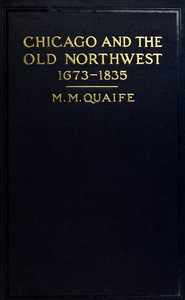
Milo Milton Quaife opens his study with a frank admission: existing histories of Chicago do not supply the want that justifies his work. He aims for a readable narrative without sacrificing scholarship, and he is explicit about his freedom from commercial motives and family partisanship—a pointed remark given the prevalence of both in local historical literature. The preface sets a tone of critical inquiry, warning that much early Chicago writing suffers from the medieval habit of accepting recorded events without challenge.
Quaife’s method becomes clear when he dissects the Kinzie family narrative, Wau Bun, calling it untrustworthy and comparing its accuracy to a medieval historical romance. He allows that some incidents have a kernel of fact, but insists that the bulk is literary imagination. This skeptical eye, trained on sources rather than received tradition, defines the work.
A Historian’s Skepticism Toward Family Narratives
Quaife’s treatment of the Kinzie family story exemplifies his approach. He notes that the family narrative recounts the rescue of Sergeant Griffith as though he were on the north side of the river during the battle, but Quaife counters that Griffith was a participant in the fight. He cites Mrs. Helm’s brief entry—'Supposed to be a Frenchman and released'—as a more reliable clue. The historian does not dismiss the story entirely; he allows that Billy Caldwell may have intervened to protect the Kinzies from a Wabash band. But he insists on separating probable fact from literary embellishment. This careful sifting of evidence, weighing a soldier’s experience against a family’s romantic memory, is typical of Quaife’s method throughout.
The Texture of Documentary Evidence
Quaife’s narrative is built from letters, official records, and firsthand accounts. A letter from Thomas Forsyth to Major Heald, dated January 2, 1813, supplies concrete details: it recounts the disappointment of 'them murdering dogs from the Wabash' who reached Chicago shortly after Heald’s departure. Quaife uses such documents to correct the Kinzie family’s timeline—the family said they left on the third day after the battle; Forsyth’s letter shows it was the fifth. The historian also reproduces a letter from William Turner to Heald, discussing pension arrangements with a tone of personal obligation: 'I always feel it my indisputable duty to render assistance to my fellow citizens… but more particularly to a brother officer.' These documents give the work a granular, evidential texture.
The Fort Dearborn Massacre: Romance Versus Record
Quaife devotes considerable attention to the Fort Dearborn massacre of 1812, but he resists the temptation to dramatize. Instead, he examines the conflicting accounts, noting that the Kinzie narrative—which had long shaped popular understanding—was largely the product of 'the author’s literary imagination.' He points to specific implausibilities: the idea that Griffith was on the north side during the battle is contradicted by his role as a participant. Quaife does not claim to have the final word; he acknowledges that his work may contain errors, especially in the chapter on the Indian trade. But his commitment to documentary rigor is clear. He writes 'without fear or favor,' challenging received tradition wherever the evidence warrants.
The Language of Frontier Authority
Quaife’s own prose is measured and declarative, avoiding the florid style of the family narratives he critiques. He describes his goal as a 'comprehensive and scholarly treatment' and his method as 'diligent study of the sources.' When he evaluates the Kinzie story, he uses phrases like 'a critical reading' and 'evident from a critical reading.' His diction is that of a professional historian addressing an academic audience, yet he aims for readability. The footnotes are dense with citations, but the main text moves forward with confidence. Quaife’s voice is that of a guide who has done the archival work and now presents his findings plainly, letting the documents speak—even when they contradict cherished stories.
Quaife’s study rewards readers who value source criticism over narrative convenience. He does not pretend to have written a definitive account; he admits uncertainty, especially on the Indian trade. But his willingness to question received tradition—and to show his working through letters, footnotes, and careful reasoning—makes this a model of early twentieth-century frontier historiography. Readers should approach the Kinzie family narrative with the same skepticism Quaife brings, and they will find in his pages a Chicago origin story built on evidence, not imagination.
There’s something humbling about watching a historian pull apart the stories we grew up on, the way Quaife does with Fort Dearborn. It makes me think of how we hold onto our own versions of the past. That same quiet reckoning lingers in With Sully into the Sioux Land — Background and Themes, where memory and landscape blur. I find myself lingering on those margins, unsure which thread to follow. It feels like coming home to a place that never quite existed.