About 125 minutes
Down the Mother Lode — Key Ideas to Explore
Science Fiction Utopias
28,730 recorded words. 13 minutes difference from this book's estimate.
View Gutenberg source #3315
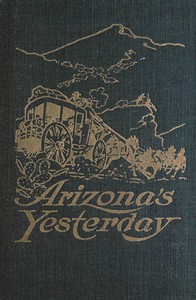
Arizona's yesterday — Reading Companion can be approached with a clearer sense of reading commitment from its source measurements: 31,612 words, 2 hr 18 min estimated reading time, and 5 detected text sections.
The text analysis averages about 24.0 words per sentence, while the detected sections provide another way to judge how the source is divided.
Project Gutenberg metadata also associates the work with “Cady, John H. (John Henry), 1846-1927,” connecting these edition facts with the source record’s subject description.
Explore this collection
These alternatives are selected using recorded categories and estimated reading time.
About 125 minutes
Science Fiction Utopias
28,730 recorded words. 13 minutes difference from this book's estimate.
View Gutenberg source #3315About 162 minutes
Science Fiction Utopias
37,245 recorded words. 24 minutes difference from this book's estimate.
View Gutenberg source #50470About 98 minutes
Science Fiction Utopias
22,535 recorded words. 40 minutes difference from this book's estimate.
View Gutenberg source #38039Search stored excerpts and compare books → Choose by your preferences →
Choices use stored catalog measurements. Estimates vary with reading speed. A shared category is a catalog label, not a claim that two books have the same argument or literary quality.
Search reads excerpt text stored with this catalog and links to its associated Gutenberg record. The connection is stored in the site database; this tool does not recheck that every excerpt is word-for-word identical to that external record. Excerpt search does not cover every chapter and does not verify historical publication dates.
Catalog snapshot checked: 2026-09-26. Coverage: 94 public books, 94 available source excerpts.
Calculated from edition completeness, EPUB availability, text structure and catalogue metadata. Not a user rating.
Total of 100 points, scaled to a 2.5-5.0 range. Editions with an empty description or a missing EPUB file are not scored.
Public-domain source text
The source text is kept in the dedicated reader, separate from this catalogue record and its commentary.
This book is not a single voice but a collaboration. The preface, written by Basil Woon, frames John H. Cady's narrative as a corrective to tourist disappointments with the modern West. Woon recounts a lady on a train who, after a brief stroll in Tucson, declared the 'wild West' a fiction. The editorial note thus begins by positioning Cady's story against a perceived gap between popular expectation and historical reality.
The narrative that follows, however, is Cady's own, and its texture is markedly different. Where Woon generalizes, Cady particularizes. The excerpt detailing the copper mine near Globe is driven by specific names—George Stevens, George Warren—and by the rhythms of prospector talk: 'You're welcome to it, George,' Cady recalls saying when Warren confided a 'hunch.' The contrast between the two authors' registers is the first clue to the book's layered construction.
Woon's preface employs a polished, almost sociological tone. He describes the 'wildest and woolliest' West as a historical fact that tourists fail to see, and he uses the lady on the train as a synecdoche for Eastern credulity. His sentences are periodic, his diction literary: 'vanguard of civilization,' 'rugged independence.' Cady's narration, by contrast, is colloquial and episodic. When Warren says 'I've got a hunch,' Cady replies with a laconic 'You're welcome to it, George.' The dialogue is unadorned, the humor dry. The effect is that Woon provides the frame, Cady the photograph.
Cady's account of the copper strike is built around a specific lexicon of mining and trading. Words like 'grub-stake,' 'pay dirt,' 'dust,' and 'hunch' recur, each carrying precise economic and social weight. A 'hunch' is not a whim but a quasi-professional intuition; Warren's reputation for reliability makes his hunches valuable. When Cady dismisses copper with 'Oh, only copper!' he reveals the historical moment when copper was worthless, a detail that grounds the narrative in material conditions. The language is never abstract; it is the language of men who measure value in ounces and dollars.
Woon's preface includes a disquisition on mining economics: the small prospector is squeezed by large smelters, forced to sell his mine at a loss. This observation is presented as 'disinterested,' yet it echoes Cady's own story of Warren's strike. The reader sees two levels of economic analysis: Woon's general principle and Cady's specific instance. The book thus offers a double perspective on frontier capitalism—one from the editorial armchair, one from the trading post. The tension between them is never resolved, and that irresolution is part of the book's interest.
The dedication 'To the pioneers who are living and to the memories of those who are dead' signals the book's commemorative intent, but the process of its creation complicates that aim. Woon explicitly states that he 'rewrote and revised' Cady's narrative. The reader is left to wonder which phrases are Cady's and which are Woon's. When Cady says 'I have never owned a mining share,' the voice feels direct, but the surrounding paragraphs may have been shaped by Woon's hand. The book is thus a palimpsest, and the attentive reader will note the seams.
Readers interested in the texture of frontier testimony will find this book a rich case study in collaborative autobiography. Pay attention to shifts in diction and to the way economic details are handled. The book does not resolve the question of who is speaking when, but that ambiguity is itself a historical document.
That rainy afternoon, Cady’s voice kept slipping between what happened and what he wished had happened, until the boundary felt less like a line and more like a fog. I set him down, and my hand wandered to The Young Engineers in Arizona; or, Laying Tracks on the Man-killer Quicksand — A Reader’s Guide. Same desert, different ghost—one of progress, stubbornly refusing to be buried.
Your answers remain private and are stored only in this browser.