About 277 minutes
Glengarry School Days: A Story of Early Days in Glengarry — Reading Notes
Adventure Picaresque Fiction
63,638 recorded words. 0 minutes difference from this book's estimate.
View Gutenberg source #3243
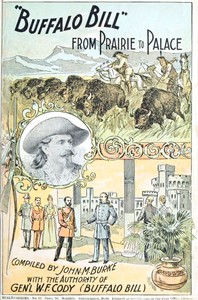
For "Buffalo Bill" from Prairie to Palace: An Authentic History of the Wild West — Reading Notes, the stored edition analysis reports 63,584 words, 4 hr 37 min estimated reading time, and 36 detected text sections.
The text analysis averages about 25.6 words per sentence, while the detected sections provide another way to judge how the source is divided.
Project Gutenberg metadata also associates the work with “Buffalo Bill, 1846-1917,” connecting these edition facts with the source record’s subject description.
Explore this collection
These alternatives are selected using recorded categories and estimated reading time.
About 277 minutes
Adventure Picaresque Fiction
63,638 recorded words. 0 minutes difference from this book's estimate.
View Gutenberg source #3243About 277 minutes
Adventure Picaresque Fiction
63,651 recorded words. 0 minutes difference from this book's estimate.
View Gutenberg source #71572About 272 minutes
Adventure Picaresque Fiction
62,426 recorded words. 5 minutes difference from this book's estimate.
View Gutenberg source #5895Search stored excerpts and compare books → Choose by your preferences →
Choices use stored catalog measurements. Estimates vary with reading speed. A shared category is a catalog label, not a claim that two books have the same argument or literary quality.
Search reads excerpt text stored with this catalog and links to its associated Gutenberg record. The connection is stored in the site database; this tool does not recheck that every excerpt is word-for-word identical to that external record. Excerpt search does not cover every chapter and does not verify historical publication dates.
Catalog snapshot checked: 2026-09-26. Coverage: 94 public books, 94 available source excerpts.
Calculated from edition completeness, EPUB availability, text structure and catalogue metadata. Not a user rating.
Total of 100 points, scaled to a 2.5-5.0 range. Editions with an empty description or a missing EPUB file are not scored.
Public-domain source text
The source text is kept in the dedicated reader, separate from this catalogue record and its commentary.
John M. Burke, who calls himself “Arizona John” on the title page, opens his authorized biography of William F. Cody with a note crediting General Dodge’s “Thirty Years Among the Indians” and the Historical Publishing Company for a few facts. This early acknowledgment signals a work stitched from multiple sources—military letters, personal recollections, and published accounts—rather than a single sustained memoir. The compiler’s preface mentions an association of some thirty years with Cody, giving the book a claim to insider knowledge, yet the text often reads like a scrapbook of episodes rather than a chronological life.
Burke’s prose moves uneasily between the dry tone of a military report and the breathless pitch of a showman’s advertisement. In the chapter on Cody’s scouting, he writes that “the campaigns of the Fifth Cavalry are matters of history, as are also the services of Buffalo Bill, the letters of the commanding officers speaking for themselves.” Here the language is clipped, almost bureaucratic. But when describing the grand buffalo hunt for the Duke Alexis, the sentences lengthen and the detail becomes lavish: “Buffalo Bill loaned the grand duke his splendid buffalo horse Buckskin Joe, and riding by his side instructed him in the manner of shooting buffaloes.” The shift is not merely stylistic—it reflects the book’s dual purpose as both a historical record and a promotional piece for Cody’s Wild West show.
The narrative rhythm accelerates noticeably when Burke recounts set-piece performances. The hunt for the Duke Alexis is paced like a staged scene: the arrival of the party, the loan of the horse, the instruction in shooting, and then the evening camp with “numbers of glasses of champagne.” Each element is arranged for maximum effect. By contrast, the earlier chapters on Cody’s boyhood and his first Indian kill move more slowly, with fewer dramatic flourishes. This uneven tempo suggests that Burke, who worked as Cody’s press agent, was more comfortable writing about the theatricalized frontier than the actual one. The book’s structure—moving from prairie to palace—mirrors this acceleration, as the later European chapters compress time and emphasize spectacle over survival.
Certain details recur with enough frequency to suggest they were part of Cody’s own storytelling repertoire. The name “Buckskin Joe” appears in the Alexis hunt episode and again in other hunting accounts. The phrase “pards of the plains” titles a chapter and echoes through the text as a term for Cody’s companions. Burke also repeatedly names the generals under whom Cody served—Forsyth, Royall, Carr, Hazen, Penrose—as if to certify his subject’s credentials by association. These repeated elements create a texture of authenticity, even when the narrative itself is episodic. They function like a verbal brand, reminding the reader that this is an authorized version, one that Burke compiled “with the authority of Gen’l W. F. Cody.”
Burke inserts himself into the text in small but telling ways. The dedication “to those pioneers of progress” and the preface’s mention of “opportune meetings and conversations with comrades” give the book a personal frame. Yet the voice throughout is oddly impersonal—Burke rarely uses the first person, preferring the third-person “compiler” or the passive construction. This creates a tension between the book’s claim to firsthand knowledge and its actual distance from the events. The reader is left to wonder how much of the narrative comes from Cody himself, how much from other sources, and how much from Burke’s own invention. The result is a hybrid work that feels less like a biography and more like a collaborative performance.
Readers should approach this book as a document of how Buffalo Bill wished to be remembered, not as a neutral history. The shifts in pace and voice are clues to its composite nature. Pay attention to the moments when the prose becomes most theatrical—those are likely the passages where Burke was most involved. The military letters and official commendations in the appendix offer a counterpoint to the showman’s prose, providing a more restrained account of Cody’s services. Comparing these sections can reveal the distance between the frontier scout and the stage persona.
There’s something about the way Burke traces Cody’s life that feels a little like watching a campfire—each story glowing, then fading into the next. I kept thinking about that same quiet ache after finishing Buffalo Bill, a longing for wide-open places. Then I came across The Rider of the Mohave: A Western Story — Themes and Context, and it stirred that same gentle, wistful feeling. One lingering echo, really.
Capture what you thought, learned, and would like to remember.
![Cover of Last of the Great Scouts: The Life Story of William F. Cody ["Buffalo Bill"] — Context and Discussion](https://inesb.com/storage/media/covers/pg1248.jpg)








