About 277 minutes
Glengarry School Days: A Story of Early Days in Glengarry — Reading Notes
Adventure Picaresque Fiction
63,638 recorded words. 0 minutes difference from this book's estimate.
View Gutenberg source #3243
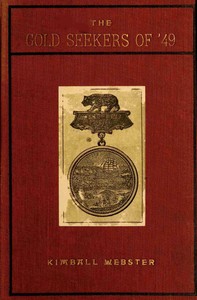
The gold seekers of '49 — Context and Discussion can be approached with a clearer sense of reading commitment from its source measurements: 63,651 words, 4 hr 37 min estimated reading time, and 8 detected text sections.
The text analysis averages about 19.4 words per sentence, while the detected sections provide another way to judge how the source is divided.
Project Gutenberg metadata also associates the work with “Frontier and pioneer life -- California,” connecting these edition facts with the source record’s subject description.
Explore this collection
These alternatives are selected using recorded categories and estimated reading time.
About 277 minutes
Adventure Picaresque Fiction
63,638 recorded words. 0 minutes difference from this book's estimate.
View Gutenberg source #3243About 277 minutes
Adventure Picaresque Fiction
63,584 recorded words. 0 minutes difference from this book's estimate.
View Gutenberg source #49204About 272 minutes
Adventure Picaresque Fiction
62,426 recorded words. 5 minutes difference from this book's estimate.
View Gutenberg source #5895Search stored excerpts and compare books → Choose by your preferences →
Choices use stored catalog measurements. Estimates vary with reading speed. A shared category is a catalog label, not a claim that two books have the same argument or literary quality.
Search reads excerpt text stored with this catalog and links to its associated Gutenberg record. The connection is stored in the site database; this tool does not recheck that every excerpt is word-for-word identical to that external record. Excerpt search does not cover every chapter and does not verify historical publication dates.
Catalog snapshot checked: 2026-09-26. Coverage: 94 public books, 94 available source excerpts.
Calculated from edition completeness, EPUB availability, text structure and catalogue metadata. Not a user rating.
Total of 100 points, scaled to a 2.5-5.0 range. Editions with an empty description or a missing EPUB file are not scored.
Public-domain source text
The source text is kept in the dedicated reader, separate from this catalogue record and its commentary.
Kimball Webster's narrative, first published in 1917, is built around a journal he kept during his overland journey and subsequent years in California and Oregon. The text opens with a biographical sketch noting his death before the book's completion, framing the account as a retrospective shaped by memory. Webster explicitly states he will record only what he "distinctly remember[s]," a claim that colors the reader's sense of reliability. The excerpts reveal a writer more interested in practical transactions than dramatic adventure: a contract to cut one hundred cords of wood at $6.50 per cord, the dimensions of a ditch excavation, and the fuel supply for a steamboat. This focus on labor and commerce distinguishes the work from more sensational gold-rush accounts.
Webster introduces his narrative by acknowledging the gap between his present age—over sixty-five—and the events of 1849. He admits that many incidents may be "forgotten altogether" or only faintly recalled. This candor about memory's limits is unusual for the genre. Rather than claiming total recall, he promises only "a few of the leading incidents" from his residence in California and Oregon until August 1854. The excerpts show a methodical mind: he notes the date of an accident with a boat (January 9, 1850), the resumption of work, and the exact dimensions of a ditch for a fence on three sides of a ten-acre field. These details suggest that his original journal, mentioned in the biographical sketch, provided a scaffold for the later narrative. Readers should expect a text that values precision over embellishment, even when the author acknowledges the fallibility of his memory.
The excerpts devote considerable space to the terms of work, not to the thrill of striking gold. Webster describes a contract to cut wood for a steamboat, specifying length (three feet), splitting requirements, and price ($6.50 per cord). He notes that no deduction would be made for short length—a detail that reveals the bargaining realities of the camps. His companions are identified by their skills: Pinney, a native of Vermont, had cut cord wood for nine months each year and was "noted in Pelham as being an expert chopper." Webster and Butler, by contrast, "had never cut very much cord wood." The narrative thus becomes a record of how different kinds of New England labor translated to California. The steamboat itself, the Vezie, was built in Maine and shipped around Cape Horn, a reminder of the industrial infrastructure behind the gold rush. These passages ground the adventure in the mundane economics of supply and demand.
Webster's account of Yuba City and Marysville offers a snapshot of urban competition in the early 1850s. He notes that Yuba City had "the first beginning" but Marysville later "outrivaled her and became the more important place." The description is precise: Marysville was "composed of very few buildings, with the exception of Nye's ranch, which was one of the old California adobe ranches." The two settlements were rivals for the title of "city," each hoping to become the head of steam navigation on Feather River. Webster mentions small steamers plying between Sacramento, Yuba City, and Marysville, including the flat-bottomed Vezie. The rivalry is presented without drama, as a matter of fact. This understated treatment of a potentially colorful subject is characteristic of Webster's style: he reports the competition but does not embellish it. The reader gains a clear sense of the region's geography and economic logic without sensationalism.
Webster's narrative rewards readers who attend to the practical details of contracts, labor, and transportation. The author's methodical approach—shaped by his training as a surveyor and his habit of journal-keeping—offers a counterpoint to more romanticized gold-rush stories. The excerpts suggest a work that is valuable precisely for its ordinariness: the daily calculations of a man who saw California not as a land of instant riches but as a place where hard work, skill, and negotiation determined success. Readers should approach the text as a primary document of economic and social history, not as a tale of adventure.
Reading Kimball Webster’s dry ledger of wood-cutting and river rivalries, I kept thinking of another California story—a quieter one, tucked into the chaparral. The Gold Seekers of ’49 is all open ground and hard contracts, but it left me wanting the shadowed, secret edges of the same landscape. That’s where The Mine with the Iron Door — Key Ideas to Explore seems to wait, patient as dusk.
Capture what you thought, learned, and would like to remember.
![Cover of Last of the Great Scouts: The Life Story of William F. Cody ["Buffalo Bill"] — Context and Discussion](https://inesb.com/storage/media/covers/pg1248.jpg)








