About 260 minutes
Ronicky Doone — Key Ideas to Explore
Fantasy Juvenile Worlds
59,773 recorded words. 3 minutes difference from this book's estimate.
View Gutenberg source #11880
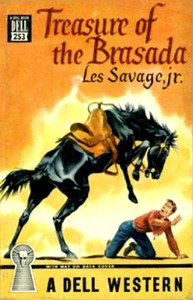
The catalog record for Treasure of the Brasada — Edition Insights provides practical reading context through 60,354 words, 4 hr 23 min estimated reading time, and 6 detected text sections.
The text analysis averages about 13.0 words per sentence, while the detected sections provide another way to judge how the source is divided.
Project Gutenberg metadata also associates the work with “Western stories,” connecting these edition facts with the source record’s subject description.
Explore this collection
These alternatives are selected using recorded categories and estimated reading time.
About 260 minutes
Fantasy Juvenile Worlds
59,773 recorded words. 3 minutes difference from this book's estimate.
View Gutenberg source #11880About 253 minutes
Fantasy Juvenile Worlds
58,159 recorded words. 10 minutes difference from this book's estimate.
View Gutenberg source #4515About 281 minutes
Fantasy Juvenile Worlds
64,403 recorded words. 18 minutes difference from this book's estimate.
View Gutenberg source #72101Search stored excerpts and compare books → Choose by your preferences →
Choices use stored catalog measurements. Estimates vary with reading speed. A shared category is a catalog label, not a claim that two books have the same argument or literary quality.
Search reads excerpt text stored with this catalog and links to its associated Gutenberg record. The connection is stored in the site database; this tool does not recheck that every excerpt is word-for-word identical to that external record. Excerpt search does not cover every chapter and does not verify historical publication dates.
Catalog snapshot checked: 2026-09-26. Coverage: 94 public books, 94 available source excerpts.
Calculated from edition completeness, EPUB availability, text structure and catalogue metadata. Not a user rating.
Total of 100 points, scaled to a 2.5-5.0 range. Editions with an empty description or a missing EPUB file are not scored.
Public-domain source text
The source text is kept in the dedicated reader, separate from this catalogue record and its commentary.
Les Savage's Treasure of the Brasada opens with a character list that reads like a wanted poster, each entry a terse sketch of motive and menace. Glenn Crawford, the protagonist, is introduced through his physical symptoms: a pallor and feverishly glowing eyes from three months in a hospital, and a body that retains the restless lines of a man who has spent much time in the saddle. The narrative voice is immediate and sensory, grounding the reader in Crawford's visceral experience.
The story's central conflict is established not through plot summary but through Crawford's own damaged body. His fear of horses is not merely stated but dramatized in a scene where Quartel, a rival, pins him against a horse, triggering a panic attack that Savage renders in escalating physical detail: trembling legs, twisting stomach muscles, a dark vortex of terror. The prose shifts from controlled observation to fragmented, breathless dialogue—"Let go, please, for God's sake, let go"—as Crawford's reason dissolves.
The excerpts devote considerable space to Crawford's physical and psychological deterioration. Savage uses the body as a site of conflict, describing how the fear of horses manifests as a "clutching, stabbing pain" that spreads through his legs and lower body, then fills his chest with a "terrible constriction." The language is clinical yet visceral: muscles twist into "little involuntary knots," and the panic is compared to a cow sinking into a black bog. This attention to somatic detail gives the narrative a claustrophobic intensity, as Crawford's internal state becomes the primary arena of action.
The horse itself is rendered as a living, threatening presence: its "hot hide" wet with nervous sweat, the "ripple of its muscle" sending new waves of panic. Savage's prose mirrors Crawford's spiraling consciousness, moving from controlled observation to fragmented, repetitive cries. The scene culminates in Crawford's collapse, leaving him crouched in the dust, coughing, as Quartel's rage gives way to a satisfied smile.
Savage's narrative voice oscillates between detached third-person and a free indirect style that channels Crawford's perceptions. The opening character list is terse and almost clinical, but the prose soon becomes saturated with Crawford's sensory experience: the "animal heat" of the horse, the "subtle, insidious nails" of fear. The dialogue is similarly layered: Quartel's taunts—"What's the matter, Crawford? Are you afraid of the horse?"—are juxtaposed with Crawford's desperate pleas, creating a rhythm of provocation and collapse.
The narrative also uses repetition to convey psychological disintegration. Crawford's cries of "Let go" and "leggo" become a refrain, stripped of grammar as panic takes hold. This technique, combined with the physical detail, suggests a body that has become unreliable, a source of betrayal rather than agency. The reader is left uncertain whether Crawford's fear is purely psychological or has a physiological basis, a ambiguity that the character Dr. Huerta seems keen to exploit.
The pacing in the excerpts is carefully calibrated to build tension. The scene begins with Crawford stumbling backward into the horse, a seemingly minor accident that quickly escalates. Savage uses short, staccato sentences to quicken the rhythm: "He was shoved back hard against the horse again, and the hot, living, hairy, animal resilience of it against his back intensified that vague alarm inside him." The accumulation of adjectives—"hot, living, hairy, animal"—slows the reader momentarily, then the action accelerates.
As Crawford's panic peaks, the sentences become fragmented: "It was no longer small or vague in him. It filled his whole consciousness." The dialogue devolves into screams, and the horse's whinny and movement add a chaotic auditory layer. The release comes abruptly when Quartel steps back, and Crawford falls to his knees. The dust settles, and the scene ends in a tableau of humiliation. This pattern of slow build, rapid escalation, and sudden release characterizes the narrative's approach to crisis, leaving the reader breathless and eager for the next confrontation.
The Texas brush country is not merely a backdrop but an active force in the narrative. The excerpts evoke a world of dust, heat, and nervous animals, where the environment mirrors Crawford's internal turmoil. The horse is described as having a "hot hide" wet with sweat, and the movement of the animal raises a "flurry of dirty brown dust." This sensory detail grounds the psychological drama in a physical reality that feels oppressive and inescapable.
Savage also uses the setting to reinforce themes of isolation and vulnerability. The scene takes place against a fence, with Crawford pinned between the horse and the bars, a spatial metaphor for his entrapment. The crowd that gathers—Aforismo, Quartel, others—offers no help; they are spectators to his breakdown. The brush country, with its wildness and lawlessness, becomes a stage for the exposure of weakness, where a man's fear can be exploited as readily as his courage.
Treasure of the Brasada rewards attention to its physical and psychological textures. Savage's prose is at its most effective when rendering Crawford's bodily experience, and readers attuned to the interplay of voice, pace, and setting will find a western that operates as much through interior crisis as exterior action. The excerpts suggest a narrative that builds its drama from the ground up, through the weight of a horse's flank and the tremor of a man's legs.
Reading about Glenn Crawford’s quiet terror of horses made me think of that old Hamlin Garland book, A Son of the Middle Border — Edition Insights. It has that same raw ache of needing to face what frightens you, not because you’re brave, but because the land simply asks it of you. It lingered, softly.
Capture what you thought, learned, and would like to remember.









