About 316 minutes
Falcon, of Squawtooth — A Reader’s Guide
Historical Psychological Social Fiction
72,644 recorded words. 5 minutes difference from this book's estimate.
View Gutenberg source #70785
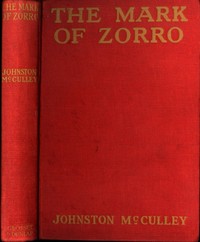
The catalog record for The mark of Zorro — A Reader’s Guide provides practical reading context through 71,418 words, 5 hr 11 min estimated reading time, and 8 detected text sections.
The text analysis averages about 13.9 words per sentence, while the detected sections provide another way to judge how the source is divided.
Project Gutenberg metadata also associates the work with “Western stories,” connecting these edition facts with the source record’s subject description.
Explore this collection
These alternatives are selected using recorded categories and estimated reading time.
About 316 minutes
Historical Psychological Social Fiction
72,644 recorded words. 5 minutes difference from this book's estimate.
View Gutenberg source #70785About 333 minutes
Historical Psychological Social Fiction
76,403 recorded words. 22 minutes difference from this book's estimate.
View Gutenberg source #39401About 358 minutes
Historical Psychological Social Fiction
82,112 recorded words. 47 minutes difference from this book's estimate.
View Gutenberg source #24352Search stored excerpts and compare books → Choose by your preferences →
Choices use stored catalog measurements. Estimates vary with reading speed. A shared category is a catalog label, not a claim that two books have the same argument or literary quality.
Search reads excerpt text stored with this catalog and links to its associated Gutenberg record. The connection is stored in the site database; this tool does not recheck that every excerpt is word-for-word identical to that external record. Excerpt search does not cover every chapter and does not verify historical publication dates.
Catalog snapshot checked: 2026-09-26. Coverage: 94 public books, 94 available source excerpts.
Calculated from edition completeness, EPUB availability, text structure and catalogue metadata. Not a user rating.
Total of 100 points, scaled to a 2.5-5.0 range. Editions with an empty description or a missing EPUB file are not scored.
Public-domain source text
The source text is kept in the dedicated reader, separate from this catalogue record and its commentary.
The opening chapter, 'Pedro, the Boaster,' establishes a tone of theatrical menace. Sergeant Gonzales sprawls before a fire, draining wine and declaring, ''Tis a night for evil deeds!' while the storm howls outside. The prose leans into melodrama—wind 'shrieked like a soul in torment'—and immediately signals a world where power is asserted through physical presence and casual cruelty. The sergeant's belief that 'a man should look out for his own comfort before considering others' is presented not as villainy but as a social norm.
This tension between individual will and communal expectation runs through the excerpts. The whipping of Fray Felipe in Chapter XXI crystallizes the conflict: a frail old man stripped of his robe, lashed for swindling and 'words of treason,' while the crowd jeers. Don Diego watches, counts the lashes, and turns away—a moment that foreshadows the masked rebellion to come.
Sergeant Pedro Gonzales is introduced through physical dominance: 'great feet,' 'great size and strength,' and a sword hilt always within reach. His boastfulness is not merely personal—it reflects a system where authority is performed. The landlord fills his mug 'hastily,' fearing the sergeant's 'terrible' temper. This dynamic repeats in the trial scene, where the magistrado grins and the sentence is carried out with theatrical precision: the robe removed, the whipping post used for 'insubordinate natives.'
McCulley emphasizes the gap between official justice and actual power. The fray is sentenced for 'swindling' and 'treason,' but the real crime seems to be challenging the hierarchy. Don Diego's reaction—'his face went white'—shows he understands the farce, yet he initially obeys the magistrado's warning that interfering would mean raising 'hand against his excellency.' The novel thus sets up a world where rebellion requires not just courage but a complete rejection of the social script.
Don Diego Vega's household includes Bernardo, a 'deaf and dumb native servant' who cannot speak, hear, write, or read. Don Diego calls him 'a gem' and 'the one man in the world to whom I can speak without having my ears talked off.' This odd detail suggests that silence—or the appearance of it—is a form of protection. Bernardo's muteness makes him a safe confidant, but also a tool: Don Diego can speak freely without fear of betrayal.
The whipping scene reinforces this theme. Fray Felipe, stripped of his robe, declares, 'I am man now, not fray!' and fights back with the whip, cutting a soldier across the face. But the crowd beats him down. The old man's brief rebellion is crushed, and he is lashed to the post 'without making the slightest sound of pain.' His silence becomes a form of dignity, a refusal to give the spectators the satisfaction of hearing him cry out. Don Diego, too, turns away—a silent witness who will later act in disguise.
The novel opens with a 'sheet of rain' beating against 'red Spanish tile' and wind that 'shrieked like a soul in torment.' This storm is not mere atmosphere; it is a moral signal. Sergeant Gonzales declares it 'a night for evil deeds,' and the weather recurs as a backdrop for injustice. The whipping takes place in the plaza, presumably under an open sky, and the natives' laughter mingles with the lash's 'singing.'
McCulley uses the storm to blur the line between natural and human violence. The wind 'howls' and 'demons are in the raindrops,' but the real demons are the magistrado, the soldiers, and the jeering crowd. Don Diego's house, by contrast, is a space of controlled calm—he orders Bernardo sent to him, speaks in measured tones, and plans his response. The storm outside mirrors the chaos of a society where power is arbitrary, while the interior suggests the possibility of order, however fragile.
Readers should attend to the way McCulley builds suspense through small, telling details: the sergeant's wine mug, the magistrado's grin, the old fray's sudden burst of strength. The excerpts do not reveal Zorro's identity or the full arc of the plot, but they establish a world where masks—literal and figurative—are necessary for survival. The tension between public performance and private conscience drives the narrative, and the storm is never far away.
What lingers for me isn’t the swordplay but that quiet moment before the mask goes on—the weight of choosing a life between two names. McCulley’s California feels shadowed by something similar in these reminiscences, where gold-fever towns hold their own kind of double lives. I think of them together, sometimes, those separate struggles for identity. Here is The Argonauts of California: being the reminiscenses of scenes and incidents that occurred in California in the early mining days — Text and Context—a rougher, brighter world, equally unsure who anyone truly is.
A brief reflection can help important ideas stay with you longer.