About 43 minutes
Bound south — Context and Discussion
Fantasy Juvenile Worlds
9,806 recorded words. 13 minutes difference from this book's estimate.
View Gutenberg source #78339
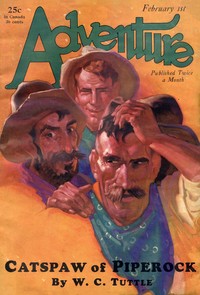
The catspaw of Piperock — Text and Context can be approached with a clearer sense of reading commitment from its source measurements: 12,811 words, 56 min estimated reading time, and 2 detected text sections.
The text analysis averages about 15.2 words per sentence, while the detected sections provide another way to judge how the source is divided.
Project Gutenberg metadata also associates the work with “Western stories,” connecting these edition facts with the source record’s subject description.
Explore this collection
These alternatives are selected using recorded categories and estimated reading time.
About 43 minutes
Fantasy Juvenile Worlds
9,806 recorded words. 13 minutes difference from this book's estimate.
View Gutenberg source #78339About 34 minutes
Fantasy Juvenile Worlds
7,791 recorded words. 22 minutes difference from this book's estimate.
View Gutenberg source #70645About 27 minutes
Fantasy Juvenile Worlds
6,200 recorded words. 29 minutes difference from this book's estimate.
View Gutenberg source #65949Search stored excerpts and compare books → Choose by your preferences →
Choices use stored catalog measurements. Estimates vary with reading speed. A shared category is a catalog label, not a claim that two books have the same argument or literary quality.
Search reads excerpt text stored with this catalog and links to its associated Gutenberg record. The connection is stored in the site database; this tool does not recheck that every excerpt is word-for-word identical to that external record. Excerpt search does not cover every chapter and does not verify historical publication dates.
Catalog snapshot checked: 2026-09-26. Coverage: 94 public books, 94 available source excerpts.
Calculated from edition completeness, EPUB availability, text structure and catalogue metadata. Not a user rating.
Total of 100 points, scaled to a 2.5-5.0 range. Editions with an empty description or a missing EPUB file are not scored.
Public-domain source text
The source text is kept in the dedicated reader, separate from this catalogue record and its commentary.
The narrator, Ike Harper, speaks in a colloquial, first-person voice that immediately establishes the tone: rueful, dry, and fond of understatement. When Dirty Shirt Jones claims to have found religion, Ike retorts, “All depends on how heavy your underclothes are.” This exchange typifies the story’s humor—spiritual pretension deflated by practical, bodily concerns. The setting is December in Piperock, Montana, where the cold is so bitter that only one tree stands between the town and the North Pole. The excerpts show a narrative that moves from reflective, almost philosophical asides to rapid-fire comic action, often within a single paragraph. The voice is consistent: Ike’s wry observations anchor the chaos, while the dialogue of other characters—like Magpie Simpkins’s malapropism “We’re one and indigestible”—adds layers of verbal comedy.
Ike Harper’s narration controls the story’s rhythm. He begins with slow, ruminative sentences: “I’ve knowed lots of men who got religion jist like Dirty Shirt and Scenery got it. Remorse, that’s what she was—not religion.” The pace here is deliberate, almost philosophical. But when action erupts—such as the chaotic Christmas show—Ike’s sentences shorten and stack: “Wham! A bullet fanned my ear, and down came the star—ker-plank! I ducked down and rolled in behind a corner of the curtain.” The shift is abrupt, mirroring the sudden violence. Ike also uses parenthetical asides to slow or speed the narrative. For instance, he describes Dirty Shirt’s eye “sorta roamed around indefinite-like, usually comin’ to rest with the pupil lookin’ down the length of his nose, as though amazed at the crookedness of said organ.” This digression pauses the action to deliver a character sketch, then releases it again. The result is a narrative that feels conversational and unpredictable, with Ike as a guide who can linger or sprint at will.
The excerpts reveal that much of the humor comes from overlapping, interruptive dialogue. During the show, characters speak over each other: “And they looked and were much amazed,” begins Testament, only to be cut off by Araby the camel’s braying: “Hoo-o-o-o-o-a-a-a-a-aw-w-w-w-oo-o-o-o-o-a-a-a-ah!” The audience responds with yells, and Tombstone’s wife cries, “Git up and take to him, Tombstone. Git up, can’tcha?” The effect is a cacophony that mimics a real crowd. Tuttle uses this technique to accelerate the pace—the rapid exchanges create a sense of escalating disorder. In contrast, quieter moments, like Dirty Shirt’s mock-repentant “Strong drink is ragin’, Ike,” are allowed to hang, giving the reader a beat before Ike’s retort. The dialogue also reveals character through idiom: Hair Oil Heppner’s “Common etikette will tell you that it ain’t ethical to pet a man over the head with a loose boot” is both absurd and precisely phrased, showing his detached amusement. This variety in dialogue pacing—from stichomythic bursts to single, weighted lines—keeps the reader off-balance and engaged.
The story’s setting—a makeshift nativity stage in a saloon—is a source of both structure and chaos. The excerpts describe a platform with a single light source, a “big iron star,” and a stable scene with a live steer and a camel. The physical constraints of this space dictate the action: when the star falls, the room goes dark, and Ike is shot at blindly. The animals add unpredictable elements: the camel eats Ike’s whiskers, and the steer’s rear end is left exposed. Tuttle uses these props to generate slapstick. The pace quickens as the scene descends into a free-for-all: “Somebody yanked the curtains, and they began turnin’ on the lamps. Magpie took the shotgun away from me and shoved me into a corner.” The narrative mimics the frantic movement—short clauses, active verbs, and a sense of spatial confusion. Yet within this chaos, Tuttle inserts moments of stillness, like Hair Oil’s calm commentary: “This is one of the best shows I ever did see.” This contrast between physical pandemonium and verbal composure is a recurring structural device, making the comedy land harder.
Readers should pay attention to how Ike’s voice modulates between the reflective and the reactive. The excerpts suggest that the story’s humor depends on a delicate balance: the narrator’s deadpan observations against the escalating absurdity of the events. The incomplete text leaves the resolution of the Christmas show unknown, but the patterns of dialogue and physical comedy established here are likely to persist. Approach the story as a performance in itself, where the telling is as important as what is told.
That Christmas caper in Piperock stayed with me, the way chaos sometimes hides a quiet heart. It reminded me of the old cowboy’s tale, another voice from a rougher time, where a scoundrel’s story lingers soft and true. There is something tender in A Texas Cow Boy or, fifteen years on the hurricane deck of a Spanish pony, taken from real life — Reading Companion that feels like the same honest company.
A brief reflection can help important ideas stay with you longer.









