About 425 minutes
Beyond the Old Frontier: Adventures of Indian-Fighters, Hunters, and Fur-Traders — Reading Companion
Fantasy Juvenile Worlds
97,574 recorded words. 12 minutes difference from this book's estimate.
View Gutenberg source #54125
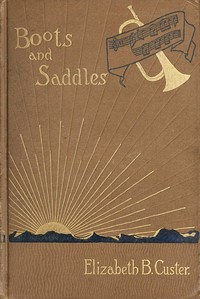
This digital edition of "Boots and Saddles"; Or, Life in Dakota with General Custer — Themes and Context is described by source-level measurements including 94,784 words, 6 hr 53 min estimated reading time, and 36 detected text sections.
The text analysis averages about 22.7 words per sentence, while the detected sections provide another way to judge how the source is divided.
Project Gutenberg metadata also associates the work with “United States. Army -- Military life,” connecting these edition facts with the source record’s subject description.
Explore this collection
These alternatives are selected using recorded categories and estimated reading time.
About 425 minutes
Fantasy Juvenile Worlds
97,574 recorded words. 12 minutes difference from this book's estimate.
View Gutenberg source #54125About 466 minutes
Fantasy Juvenile Worlds
107,022 recorded words. 53 minutes difference from this book's estimate.
View Gutenberg source #20418About 349 minutes
Fantasy Juvenile Worlds
80,238 recorded words. 64 minutes difference from this book's estimate.
View Gutenberg source #18150Search stored excerpts and compare books → Choose by your preferences →
Choices use stored catalog measurements. Estimates vary with reading speed. A shared category is a catalog label, not a claim that two books have the same argument or literary quality.
Search reads excerpt text stored with this catalog and links to its associated Gutenberg record. The connection is stored in the site database; this tool does not recheck that every excerpt is word-for-word identical to that external record. Excerpt search does not cover every chapter and does not verify historical publication dates.
Catalog snapshot checked: 2026-09-26. Coverage: 94 public books, 94 available source excerpts.
Calculated from edition completeness, EPUB availability, text structure and catalogue metadata. Not a user rating.
Total of 100 points, scaled to a 2.5-5.0 range. Editions with an empty description or a missing EPUB file are not scored.
Public-domain source text
The source text is kept in the dedicated reader, separate from this catalogue record and its commentary.
Elizabeth B. Custer opens her memoir with a preface that frames the book as a corrective to civilian ignorance about cavalry life on the frontier. She describes the isolation of posts like Fort Lincoln as akin to living on an island, and promises to answer common questions about domestic arrangements, amusements, and housekeeping. The catalog subjects list military life, frontier existence, and Indian wars, but the excerpts reveal that Custer's focus is less on combat and more on the textures of daily experience: the struggle to open windows, the pride in a husband's study filled with hunting trophies, and the careful management of a home in raw quarters.
The excerpt describing the Custers' quarters at Fort Lincoln shows how Elizabeth Custer transforms a bare, unpapered space into a home. She notes the windows that “went up with a struggle” and the “old-fashioned box-stove” reminiscent of country schoolhouses. Her husband, General Custer, claims a room of his own, stocking it with hunting trophies: a buffalo head, a grizzly bear's head with “open jaws and great fang-like teeth,” antelope heads, and a black-tailed deer shot jointly with the scout Bloody Knife. The room becomes a museum of the chase, with a Damascus-blade sabre bearing the motto “Do not draw me without cause; Do not sheathe me without honor.” This detailed inventory reveals how the Custers imposed order and personality on a harsh environment, and how the general's identity as a hunter and soldier shaped their domestic space.
Custer's narrative repeatedly emphasizes her husband's skill as a hunter and his accumulation of trophies. She recounts that he killed a grizzly bear and wrote to her, “I have reached the height of a hunter's fame—I have killed a grisly.” The bear's head is displayed alongside a sand-hill crane, a mountain eagle, and a yellow fox. The general's study also holds a collection of firearms, including Winchester and Springfield rifles, shotguns, and an old flint-lock musket. The sabre, captured during the Civil War, is described as “made of such finely-tempered steel that it could be bent nearly double.” These passages show that Custer's memoir is partly a record of her husband's prowess and possessions, offering a personal counterpoint to the official military record. The excerpts do not, however, describe any combat with Indians; the focus remains on the general's hunting and the objects that fill his room.
The table of contents lists chapters on “Incidents of Every-day Life,” “Perplexities and Pleasures of Domestic Life,” and “Domestic Trials,” suggesting that Custer's narrative dwells on the challenges of maintaining a household on the frontier. The excerpt from the preface states that the book aims to give “a glimpse to civilians of garrison and camp life,” and that the author will enter “minutely into trifling perplexities and events.” The catalog subject “United States. Army -- Military life” is thus borne out by the text's attention to the practicalities of living in a remote post. However, the excerpts do not detail interactions with Native Americans beyond the mention of Bloody Knife and the chapter titles “Camping among the Sioux” and “A Visit to the Village of ‘Two Bears.’” The reader must infer that these encounters are described elsewhere in the book; the provided material focuses on interior domesticity rather than cross-cultural contact.
Readers approaching Boots and Saddles should expect a memoir that foregrounds the author's perspective as a wife and homemaker, not a military strategist. The book's value lies in its granular detail of frontier domesticity—the struggle with stoves, the arrangement of trophies, the management of servants—rather than in battle narratives. The catalog subjects hint at Indian wars, but the excerpts suggest that Custer's account is more about endurance and adaptation than conflict. For a fuller picture of the Custers' life, one must read the chapters on Indian councils and the Black Hills expedition, which are not represented in the provided text.
Reading Elizabeth Custer’s account of making a home on the vast, lonely prairie, I found myself quietly recalling another book. There is something about her careful tending of domestic life against such immense emptiness that echoed a similar feeling of resilience. The well in the desert — Text and Context carries that same patient, almost sacred attention to scarce resources, drawing water from dry ground. Both leave a lingering sense of gentle endurance.
Use these questions to collect your thoughts before moving on.









