
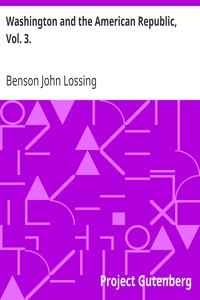
Washington and the American Republic, Vol. 3. by Benson John Lossing
Benson John Lossing’s third volume picks up right after the Revolutionary War ends. The fighting is over, but the danger isn’t. The book follows the chaotic years from 1783 to 1789, a period often glossed over in history class. We see Washington resign his military command in a stunning act that shocks Europe, then struggle to manage his Mount Vernon farm while the country he fought for teeters on the edge of collapse.
The Story
The ‘plot’ is the birth pangs of the United States. The Articles of Confederation are failing. States argue over borders and money. There’s rebellion in Massachusetts (Shays' Rebellion), and the nation has no power to tax or defend itself. Lossing tracks Washington’s growing alarm from his plantation, his behind-the-scenes letters pushing for change, and his reluctant journey to the Constitutional Convention in Philadelphia. The climax isn’t a battle, but a debate—the long, hot summer of arguing that produced the U.S. Constitution. The story ends with Washington’s unanimous election as the first President, facing the immense task of making the paper government a reality.
Why You Should Read It
This book strips away the marble statue and shows you the man. Washington here is frustrated, anxious, and deeply weary, but driven by a sense of duty that feels almost painful. Lossing’s great strength is using firsthand sources—letters, diary entries, eyewitness accounts—to make you feel the uncertainty of the moment. You realize nothing was guaranteed. The takeaway is that the nation wasn’t born in perfect harmony; it was a messy, contentious, and exhausting compromise. It makes our founding feel less like destiny and more like a miraculous, hard-won achievement.
Final Verdict
Perfect for history fans who are tired of the same old war stories and want to understand the ‘what next?’ This is for the reader who enjoys political drama and human stories over military strategy. Be warned, it’s a 19th-century history book, so the prose can be dense at times, but the drama of the era shines through. If you’ve ever wondered how we got from the Treaty of Paris to the President’s cabinet, this is your essential, ground-level guide.
No rights are reserved for this publication. Thank you for supporting open literature.
Lisa Anderson
10 months agoSurprisingly enough, it manages to explain difficult concepts in plain English. Exactly what I needed.
Liam Hill
1 year agoIf you enjoy this genre, the character development leaves a lasting impact. Thanks for sharing this review.
Jessica Rodriguez
3 months agoRecommended.
Elizabeth Martin
1 year agoUsed this for my thesis, incredibly useful.





Elizabeth Johnson
5 months agoClear and concise.